Monday, May 12, 2014

Naples - Pompeii Photo Stroll

Oh Pompeii. How I love thee!  I flashed back to 1987 pretty quickly as we entered Pompeii and remembered how much fun we had there. Thankfully I hung out with kids who were interested, mostly, in the history of the area. We were on a Spring In-program travel with two teachers (husband and wife) and 8 of us kids.  We stopped in so many historic places on the trip it was hard to keep track. Pompeii, though, never left my memory.
 
It's changed over the years. Busier and more facilities than it was back then. My first order of business was to find a restroom.  I giggled when I saw the sign. It reminded me of the sign I saw on the Canadian Cruise in Quebec City.
 

After the potty break, which our tour guide called "depositing ammonia" we hit the park.  Our tour guide was exceptional in her details and stories of Pompeii.

If you don't know, (what rock have you been under) Pompeii was buried in ash from an eruption of Mt. Vesuvius in 79AD.  The thriving town of, what the estimate, 20,000 was completely destroyed. Almost every one lost their lives. 

What's left are ruins and some artifacts that help us understand what life was like in Pompeii.


What's left of their amphitheater.

This was the fastfood of the time. These vats, they believe, were filled with soups.
The streets of Pompeii

Stepping stones...literally. The ruts in the streets were made from carts passing over the stones for years.

What the believed to be a bakery. The mill in the foreground and the stone oven in the back. They did find some breads in some of the ovens throughout Pompeii.

The roof of the bath house.

Inside the bath house.

One of the patrons of the bath house.
Then there was the brothel we saw. Fascinating to see that prostitution is the oldest form of employment.

The rooms were small and each had a cement type bed with a very thin mattress.  A patron could enter the brothel and essentially pick their flavor based on the photo above each door.


Then there were these everywhere around the brothel.  Essentially pointing the way.  Even in 79AD there was a red light district.


Several fountains were uncovered and fresh springs were found under them. This fountain was close to the forum and appeared to be well used.


And then we get to the forum.  That's Mount Vesuvius in the background. You can tell that the people of Pompeii would have had no time to get to safety once that mountain blew. Its still quite active, by the way, and it watched carefully these days.  Thousands upon thousands of people live near or around it.


Many of the buildings around the forum had this type of sign on the outdoor walls. Early day advertising. They suspect the family who owned this building were movers of some sort.
 

Still standing is a home of what appeared to be a very wealthy family.  The mosaics on the floors of this house are still in relatively good condition.


Then there were the bodies.  As you leave Pompeii they walk you past this storage area that shows all the artifacts they found while excavating Pompeii. Not too surprising they found a lot of bodies. Only they aren't really bodies.

They found as they were digging these vast hallow areas.  As they dug when they'd encounter one they got the bright idea to put plaster inside the hole to see what it was. Turned out to be what was once a person's body. The skin, clothing, bones all dust, but the plaster mold could show some pretty good detail.


This is the hardest one for me to see for some reason.

This guy was part of my original photos 28 years ago...and he's still there in the same place.

For  more Pompeii photos, and there are plenty, visit my flicker site.

And thus ends the photo stroll of the cruise. Now to get back to real blogging. I have several blogs percolating so never fear...there's more.


Sunday, May 11, 2014

Naples - Amalfi Coast Photo Stroll

Naples was one of the stops I was most looking forward to. It was the last port on the cruise, but it had two significant places I wanted to see...the Amalfi Coast and Pompeii.  I'll cover Pompeii in another post, there was just too much for one post.

We didn't drive through Naples, but skirted around it.  The people of Naples appear to live in a low income way - alright poverty almost. But I found the area enchanting all the same. Seeing how others live sometimes reminds you just how lucky you really are.

 
Naples from the bus. That's Mt. Vesuvius in the back.
Naples from the other side.
The Amalfi Coast is one of the most amazing coastlines in Italy, if not the world. Its steep shoreline gives you some of the most amazing and dramatic scenery.


The road along the coast is narrow, curvy and right up on the edge. I have to say the bus drivers who know that coast like the back of their hand is worth their weight in gold.


There were several times we had to stop to let a bunch of cars pass. Or they had these volunteers posted at two points on the road and they'd control the traffic through the narrow streets.  It was frightening and fascinating all at the same time.


The Amalfi area is known for their lemons.  Lemoncello, in fact, is manufactured using the lemons of Amalfi. These lemons were not the ones they'd use. These were mutant lemons that had a sweet, not very tart flavor to them. The rind is about 2 in thick and the flesh of the lemon inside is a very light yellow.


Once we stopped in the town of Amalfi for some free time, the first order of business was to stop for gelato. Dah. I had the Amalfi Lemon gelato. It actually tasted more like vanilla than lemon, but it didn't stop me from eating it.


Along the narrow roads of Amalfi we found stores willing to sell you just about anything. Amalfi is very much a tourist town.  Brother M noticed a line of locals in front of this fish store. As we got closer we realized they were having lunch. They were serving up fried calamari and shrimp in a paper cone cup with a slice of lemon.


The Amalfi Coast is definitely a place to see in your life time. Pack your patience though as getting there is a trial to be sure.  Its one of the busiest tourist destinations in Southern Italy.

The rest of my photos of Amalfi are here.

Saturday, May 10, 2014

Palermo, Sicily Photo Stroll

In my opinion, Palermo Sicily seemed like it's the heart of all things Italian. Some of my first memories of understanding what Italy was and Italian meant was from the Godfather. And so when it came time to go to school on the boarder of Italy I naively assumed Italy was like the Godfather.
 
Turns out ... not so much. But Sicily...oh my goodness. What a city.
 
Dirty. Grimmy. Gritty. Poverty stricken. And yet, beautiful all at the same time.
 
This is the Quattro Canti in Palermo. The piazza is octagonal, and appeared to be larger in photos than it really is. It is the intersection of major streets. Each façade is nearly identical and contain fountains with statues of the four seasons, the four Spanish kings of  Sicily, and the patronesses of Palermo (Cristina, Ninfa, Olivia, and Agata).
 
"The facades onto the interchange are curved, and rise to four floors; the fountains rise to the height of the second floor, the third and fourth floors contain the statues in niches. At the time the piazza was built, it was one of the first major examples of town planning in Europe," according to Wikipedia.


I really have no idea what building this is. After some extensive research I discovered this the Palazzo dei Normanni - or the Royal Palace of Palermo. It was where the Kings of Sicily sat during the Norman domination. Today it's where the parliament lives. 
 

The fountain of Shame ... hardly subtle. It's adorned with depictions of allegories, animal heads, nymphs, monsters, ornamental staircases and balustrades, and, of course, gods and goddesses who make up an encyclopedia of Mount Olympus.  The Fontana della Vergogna, the "fountain of shame”, is so named because of the nude statues that stand around the base of each tier, it is one of the few true pieces of High Renaissance art in Palermo.

The Church of St Ignatius of Olivella was located in the little piazza in which we were given free time. We had gelato, cappuccino and a stroll down the street to a market. I shot a few photos of the church and the surrounding statues.


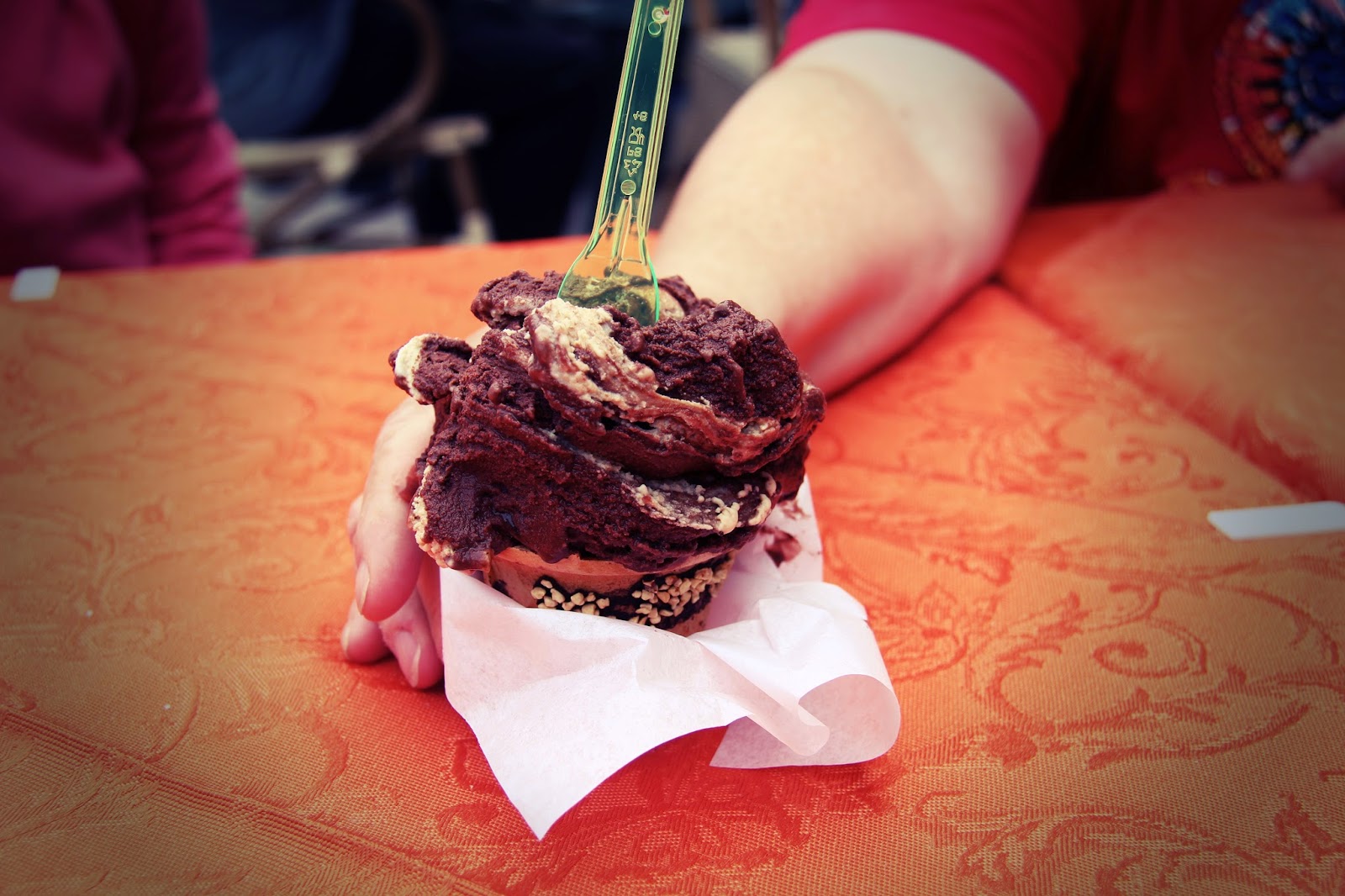
Massive scoop of gelato. I was in heaven. I let this young girl who was with her father pick my flavor. She chose well too.
What's left of my gelato and cappuccino.

Like I always do, I did some research on the type of food a region might be famous for. I came across this photo.


Photo courtesy of Imperatore Travel Blog

It looked delicious to me. Then I read what it was. It's called la Stigghiola. Then I looked it up. "The stigghiola (plural: stigghiole, also known as stigghiuola) is a Sicilian food specialty, typical of the city of Palermo. It consists of guts (usually of lamb, but also of goat or chicken) which are washed in water and salt, seasoned with parsley and often with onion and other pot herbs, then stuck on a skewer or rolled around a leek, and finally cooked directly on the grill." (Wikipedia is awesome.)

Um. YUCK. But alas, I found it and had to take a photo. Cuz that's how I roll.


This is the Teatro Massimo.  It's said to be the largest theater in Italy.  It was also used in the Godfather as the church in which a funeral took place. 


Finally, the Oratorios. These little gems were unlike anything I had seen.  I didn't get the full story behind why they existed at the time. We did get an understand that in their day they were used as a place men (who were only invited, or because a relative was a member) would come and discuss politics, religion, etc of the time.  Mom thought it was early mob. May be.

Both the oratorios we visited were sculpted by Giacomo Serpotta using stucco. Yes, stucco. I had already been amazed by how people sculpted in marble...but stucco? Amazing art.

This was the second of the oratories we visited. My photo sequence says this is the Oratorio di Rosario di Santa Cita. The first oratory we visited was called Oratorio di Santa Cita. So I'm very confused. Let's just say they are both oratories and both belong to Santa Cita somehow.

This one was significantly different in that it had paintings in it and more color.


This is the Oratory of Santa Cita (the first one we visited) - also sculpted by Giacamo Serpotta. This was the crowning achievement of the leading baroque decorator of his day. Giacomo Serpotta worked on it between 1686 and 1718. The cherubs were everywhere and I just loved how each of them seemed to have their own personality.  They could be seen sleeping, eating, and simply hugging their knees deep in thought.


This little guy and his buddies were holding up the bench that circled the oratory.
The gold frame there is the signature of the artist.


This is the top of the Garibaldi Theatre. I couldn't get any of the rest of the theater from my position on the bus. Finished in 1874, it was the first of a series of theaters built by wealthy urbanites in the second half of the 19th century.


And lastly, though it was our first stop were the Catacombs of the Capuccini Friars.  Oh....My....God...is all I can say. Well, I can, and will, say more. This little stop was one I was greatly anticipating...especially to photography.  Turned out we weren't allowed ... which has never stopped me before (see Sistine Chapel post), but we were a small group and it was super quiet down there. They would have heard my shutter so I refrained.

Instead I bought postcards and scanned them.


Again, Wikipedia says it best, "Palermo's Capuchin monastery outgrew its original cemetery in the 16th century and monks began to excavate crypts below it. In 1599 they mummified one of their number, recently dead brother Silvestro of Gubbio, and placed him into the catacombs. "

"The bodies were dehydrated on the racks of ceramic pipes in the catacombs and sometimes later washed with vinegar. Some of the bodies were embalmed and others enclosed in sealed glass cabinets. Monks were preserved with their everyday clothing and sometimes with ropes they had worn as a penance.


"Originally the catacombs were intended only for the dead friars. However, in the following centuries it became a status symbol to be entombed into the Capuchin catacombs. In their wills, local luminaries would ask to be preserved in certain clothes, or even to have their clothes changed at regular intervals. Priests wore their clerical vestments, others were clothed according to the contemporary fashion. Relatives would visit to pray for the deceased and also to maintain the body in presentable condition."

Amazing, right?

This was the first Friar to be entombed in 1599.

This was the last person put there. She's a 2 yo girl who was so well preserved, they've studied her extensively.
The rest of the story can be found here in my original blog.

The rest of the photos can be found on my Flickr site.